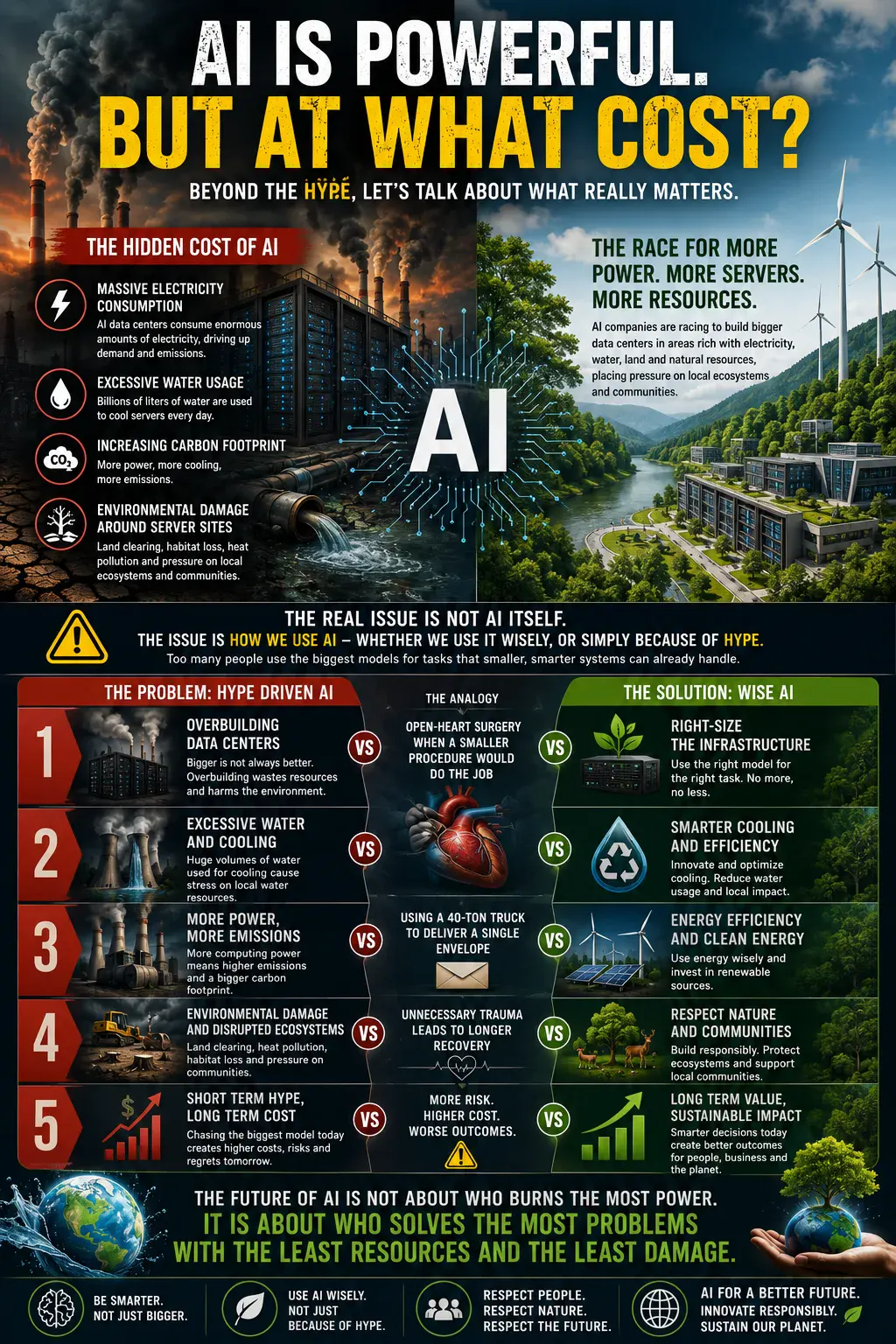
Reducing Corporate Carbon Footprint Through Responsible AI Adoption
AI adoption is growing rapidly across organisations. However, the sustainability impact depends on how AI is designed, deployed, and managed.
A company with 1,000 employees using AI daily can create significant computational demand.
Estimated usage scenario:
- 1,000 employees
- 20 AI interactions per employee per day
- 22 working days per month
Total: 1,000 × 20 × 22 = 440,000 AI requests/month
If every request is processed using large AI models without optimisation:
- Higher GPU utilisation
- More energy consumption
- Increased infrastructure demand
Estimated impact:
≈352 kg CO₂e/month
≈4.2 tonnes CO₂e/year
Through a structured AI architecture such as NeuralOps by AINNA, organisations can optimise AI usage through:
✅ Smart Routing
Selecting the right model based on task complexity, avoiding unnecessary use of high-compute models.
✅ Specialised AI Agents
Dedicated agents handle specific business functions more efficiently.
✅ Detached System Architecture
Combining AI with validation layers, rule engines, and deterministic processing to reduce unnecessary model computation.
✅ Compute & Token Optimisation
Reducing processing requirements while maintaining productivity and output quality.
With optimisation, assuming a 70% reduction in unnecessary compute:
Estimated impact:
≈106 kg CO₂e/month
≈1.3 tonnes CO₂e/year
Potential reduction: ≈2.9 tonnes CO₂e/year for a 1,000-employee organisation
The future of AI sustainability is not about using less intelligence.
It is about using intelligence more efficiently.
Responsible AI architecture enables organisations to achieve:
- Lower energy consumption
- Reduced operational cost
- Improved AI efficiency
- Lower carbon footprint
Efficient AI Infrastructure is Sustainable AI Infrastructure.
#ArtificialIntelligence #GreenAI #ESG #SustainableTechnology #CarbonFootprint #AIInfrastructure #NeuralOps #AINNA #DigitalTransformation #ResponsibleAI